About
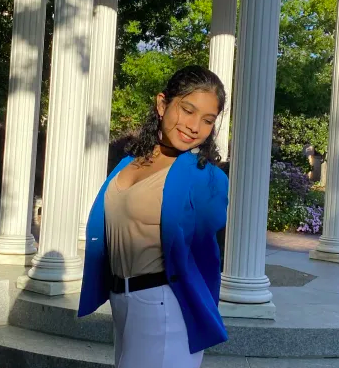
Hello! I'm Hrishika, a graduate student pursuing an M.S. in Information Science at UNC Chapel Hill, continuing from my B.S. in Information Science and Neuroscience with a minor in Computer Science through the SILS BS-MS Dual Pathway. I study how people find, use, and make sense of information.
My work lives at the intersection of human computer interaction, neural networks, and user-centered experiences. I care about building tools that are accessible, trustworthy, and actually usable. Recent projects include eye tracking engagement in AI assisted academic search, model card evaluation for brain computer interfaces, and a systematic review on how large language models are changing the way we communicate.
I've always loved science because it answered the questions I asked as a kid, how birds fly, why people dream, what makes medicine work. Over time those questions became bigger ones, like
I am driven by the conviction that education is a powerful tool for creating positive change. Long before I ever became a tutor, I was the oldest sibling. Explaining homework around the kitchen table was probably my first experience with teaching.
Since then I've tutored chemistry, founded Girls Who Code chapters, led Python workshops, mentored students, and built educational resources. Teaching others taught me that expertise isn't measured just by how much you know, but also by how well you can help someone else understand.
I find that the best learning fundamentally comes from understanding our history. From asking why and how we know what we know. We're not just collecting facts--we're understanding where those facts came from, how they're supported, and when they should be questioned. As a kid, I was told not to get in the car right after sneezing because it meant bad luck; the real root of that was probably practical, don't spread illness, or don't drive when you might sneeze, but stripped of its reasoning it survived as pure superstition. I enjoy tracing ideas back to their origins rather than accepting it at face value, because understanding the history and reasoning behind an idea makes it easier to question, adapt, and build upon.
I ended up in the information science field because I wholeheartedly believe that--as Dr. Cassidy Sugimoto said in her commencement address at my graduation--"data and information only matters so far as they help people to live fuller and freer lives." I don't think knowledge something we simply accumulate; it's something we build by making connections between ideas, disciplines, and people.
It's still the philosophy I try to bring into everything I build:
Using technology to make life a little easier, communication a little clearer, and systems a little more human.
I take complex ideas and make them understandable and usable. That thread connects a background in neuroscience and computer science, a graduate degree in information science, and over a decade of explaining ideas at science fairs, in classrooms, and on stages.
Research has been a constant throughout my life. I've presented work on biotechnology, nanotechnology, and human computer interaction at competitions including ISEF, AJAS, BioGENEius, and the NC International Science Challenge. As co founder of SkyeLabs Innovation Inc. I co-developed EcoGel, a sustainable biopolymer aerogel that won the Pete Conrad Scholar award and earned a NASA iTech Top 10 Finalist spot with the sole Honorable Mention as the youngest team ever recognized.
Outside of research, I love spending time around the arts. I'm passionate about music, theatre, and dance. I've trained in Bharatanatyam for over a decade, competed in Shakespeare and Speech and Debate, and can usually be found writing lyrics or tapping my feet to whatever happens to be playing. I think those experiences have made me a better communicator as much as a better performer; they've taught me how stories, rhythm, and emotion shape the way people understand ideas.
Today I serve as an SDIS Ambassador and Student Advisory Board member, co-president of UNC Zero Degrees, and president of UNC Girls Who Code's College Loop chapter. I previously served as Editor-in-Chief of the Broad Street Scientific, NCSSM's official journal of student STEM research.
Right now: finishing my M.S. in Information Science at UNC while running an eye-tracking study on how students search with AI, leading UNC Zero Degrees and the Girls Who Code college loop, and slowly turning this website and its garden into the digital notebook I've always wanted to keep.
Outside work, I'm rereading The Stormlight Archive, chipping away at songs that never seem to stay finished, and trying to convince myself that one more side project is a reasonable idea.
Research and methods: mixed-methods and between-subjects study design, usability testing, think-aloud protocols, survey-instrument design, systematic review (PRISMA, citation chasing, evidence mapping), statistical analysis (Mann-Whitney U, Spearman's rho, mixed-effects regression), Cognitive Load Theory (DCLQ) and the System Usability Scale, and model-card explainability evaluation.
Programming: Python, JavaScript, SQL, Java, C, HTML and CSS, React, R, Node.js, Three.js, AJAX, and Dart/Flutter.
Machine learning and data: TensorFlow and Keras, MNE (EEG), CNN architectures (EEGNet, DeepConvNet, ShallowConvNet), and data visualization with Leaflet and Highcharts.
Tools and platforms: Git and GitHub, FHIR, Figma, WordPress, Wix, Notion, Microsoft Office (Excel, Word, PowerPoint), Google Suite, Adobe Photoshop and Acrobat, Obsidian, Zotero; familiar with SDLC, Agile and Waterfall, and CI/CD.
Design and fabrication: ChimeraX, Blender, TinkerCAD, Onshape, AutoCAD, and Twine; 3D printing (FDM, PLA and PETG); computational chemistry (Schrodinger Maestro, Gaussian, WebMO, MATLAB).
Focus areas: human-computer interaction, UX research, accessibility, AI and ML evaluation, health informatics, and science communication.
Languages: English and Bengali (fluent), Spanish (proficient), Hindi (novice).